
Activewear Supplier Contracts: What Should Be in Writing
Here is the mistake I see most often: a founder spends weeks choosing a factory, then treats the contract as paperwork to be signed quickly so production can start. The contract is not paperwork. It is the only thing that decides what happens when the fabric is late, the colour is wrong, or the shipment misses your launch. A good activewear supplier contract answers four questions before they become arguments: what exactly is being delivered, when is each date triggered, what counts as accepted, and who pays when something goes wrong. Get those four in writing and most disputes never start.
Quick Answer
Before production, put four things in writing with your activewear factory: (1) a product spec sheet that names styles, colours, sizes, fabrics, construction and approved sample; (2) three separate dates — production complete, shipment, and arrival — each tied to a specific event and document; (3) an acceptance mechanism and payment triggers, with the balance linked to an acceptable inspection result, closed corrections and required documents; and (4) a delay and failure-inspection process with notice periods, remedies and cost allocation. Keep purchase-order details and master-agreement rules in the right files, and reference one unique version of every attachment.
This is practical drafting guidance, not legal advice. The example clauses below are negotiation starting points, not text you can drop into any deal. Cross-border orders should be reviewed by a lawyer familiar with the governing law.
A contract does not need to be long to work. It needs to be specific where it matters. The rest of this guide walks through the four questions a brand buyer should settle before an activewear order goes into production.

The goal is not a thicker contract. It is fewer places where two people can read the same sentence differently. (AI-generated image)
1. What Should the Contract Say About Specs and Delivery?
Start with the most basic question: which exact garments is the factory promising to make, and when does "on time" actually happen? A manufacturing agreement usually defines the requirements in a specification attachment, while each purchase order sets quantity, dates and shipping instructions for that order. The two need to connect, not contradict each other.
Write the product requirements as a checklist someone can verify
"Make it like the sample" will not survive a disagreement. Put the following into the order, or reference a numbered attachment. A spec sheet should control the things a buyer will actually check on arrival.
| Item | What to write down |
|---|---|
| Product identity | Style number, product name, and how different styles relate to each other |
| Colours and quantities | Colour number or approved colour standard, quantity per colour and size, allowed quantity variance |
| Fabrics and trims | Fibre content, construction, GSM and tolerance; elastic, cups, zips and label specs; whether substitutions are allowed |
| Construction and sizing | Size chart, tolerances, seam type, stitch density, reinforcement points, branding method and placement |
| Performance | Stretch and recovery, colour fastness, shrinkage and other relevant tests — with method and acceptance criteria |
| Samples and documents | Approved sample number, approval date, tech pack filename and version, open comments not yet closed |
| Packing and labels | Care and composition labels, size labels, barcodes, individual packing and carton requirements |
One detail worth arguing about now: what does the approved sample actually control? Say it controls appearance, hand feel and construction, while size tolerances and test results are controlled by the written documents. Otherwise "the sample wins" sounds fair until the sample and the size chart disagree — and then nobody has a rule. If you want the full list of what goes into a factory-ready pack, our design protection guide covers ownership of those documents too.
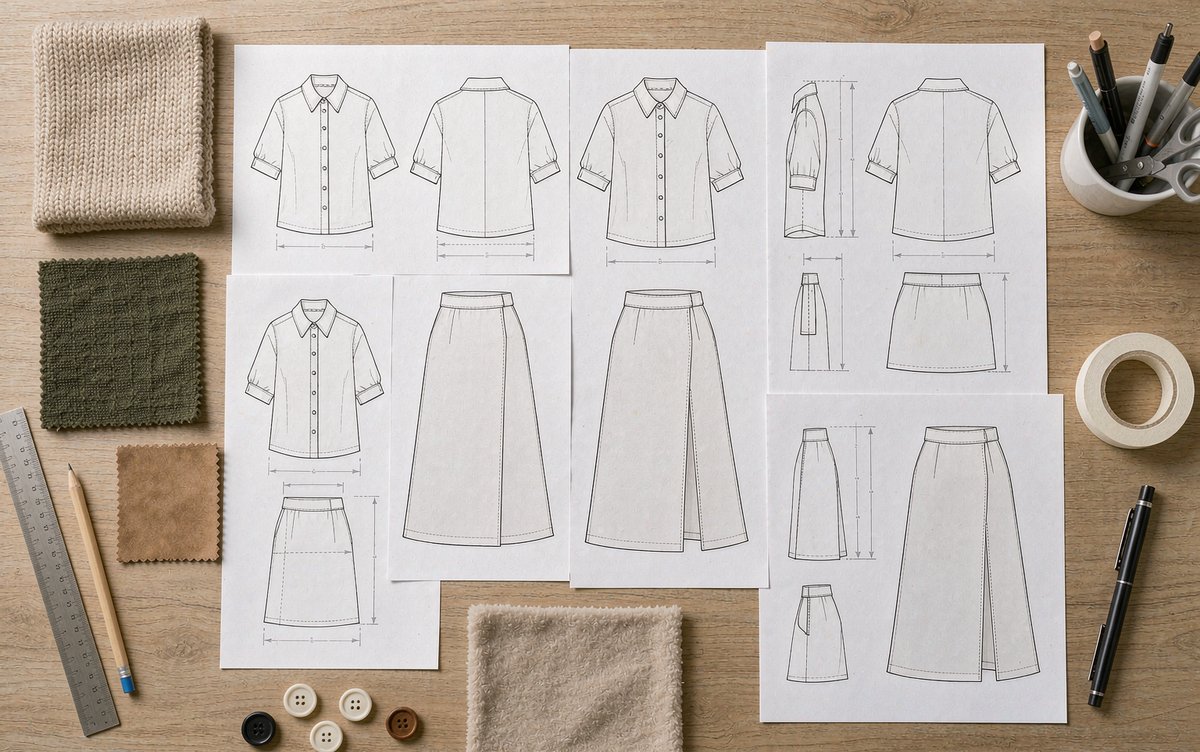
A specification attachment turns "like the sample" into a list two sides can check line by line. (AI-generated image)
Define three dates, not one
"Ship date" is the most overloaded word in apparel sourcing. Split it into three and attach a document to each.
| Date | Suggested definition | Evidence |
|---|---|---|
| Production complete | The agreed quantity has finished production, finishing and internal checks, and is ready for inspection at the agreed standard — state whether packing is included | Completion count, internal inspection and packing records |
| Shipment | Pick one event: handover to named forwarder, handover to carrier, or actual loading on board. Do not mix them | Receipt, handover or transport document for the chosen event |
| Arrival | Which point — named port, airport or final warehouse — and whether it is a guaranteed or estimated date | Arrival notice, signed receipt or warehouse receiving record |
Everyday language and trade terms do not mean the same thing. "Delivered to you" in conversation is not the same as delivery under an Incoterm. Under FOB, delivery and risk transfer happen when the goods are loaded on board at the named port of shipment — not when the cartons reach your warehouse. So write the rule version and the place, for example "FOB Shenzhen, Incoterms® 2020", then state your completion, departure and arrival commitments separately. Writing "FOB" alone does not settle any of those dates. The ICC academy explanation of place of delivery and risk transfer is a useful reference; confirm the current rule text before you rely on it.
2. How Should You Set Quality, Acceptance and Payment Terms?
Four separate events tend to get collapsed into one: production finished, inspection passed, buyer accepted, payment due. A contract that treats them as the same thing is where balance-payment disputes come from. An inspection report can support a claim for correction; whether the balance is due still depends on what the payment clause says.
Build the acceptance mechanism first
Cover at least five points.
- Who inspects: factory QC, a buyer representative, or a buyer-appointed third party. Say whether the internal check is only a preparation step.
- When: what production and packing state is required, how much notice the factory gives, and who books the inspection.
- Against what: the tech pack, approved sample, size tolerances, test methods, defect categories and sampling plan.
- What passes: which issues fail the order, which can be corrected and re-checked, and who may approve a concession.
- After arrival: the window for reporting obvious defects, and how hidden problems not caught by a pre-shipment sample are raised.
A quality clause should include a rejection window, how non-conforming goods are handled, and who pays for re-inspection — not just "goods shall meet quality standards." Our factory audit guide covers checking the factory before you sign; this clause is what protects you after.
When should the balance actually be paid?
From a brand buyer's point of view, the safer structure is to link the balance to defined inspection and document conditions, then pay within a set period — not to trigger it the moment the factory says production is finished.
| Payment stage | Conditions to write in |
|---|---|
| Deposit | Both sides confirm the order and applicable documents; factory issues pro forma invoice. If key specs are still open, state whether the deposit authorises material purchase or production start |
| Balance | Acceptable inspection result, required corrections and re-inspections closed, agreed documents received — then paid within a stated number of working days |
| Retention, if agreed | Amount or percentage, post-arrival inspection window, and the date it is released if no valid claim is made |
A clause like this is a useful starting point for discussion:
The balance is payable within [X] working days after the buyer receives an acceptable report from the agreed inspector, confirmation that required corrective actions are closed, and the agreed payment documents. A factory statement that production is complete does not, by itself, make the balance due.
Add two more things. First, say how long the buyer has to confirm the report after receiving it — otherwise "pay after buyer approval" has no deadline. Second, decide what happens when only part of the order is in dispute: can the buyer accept and pay the unaffected portion, or is the whole shipment held? Neither is automatic. A neutral inspection service produces evidence; the right to pay, reject or release stays with the contract. For the mechanics of T/T, deposits and trade terms themselves, see our payment terms guide.
3. What If the Factory Delivers Late or the Order Fails Inspection?
The useful question is not "who is responsible" in the abstract. It is: when must they tell you, how is the impact confirmed, who fixes it, who pays, and after how long can you choose another route. Set the process for delay and quality failure separately.
| Issue | What to agree |
|---|---|
| Delay notice | Factory notifies in writing within a set period of learning about a possible delay — not on the original ship date |
| Impact statement | Cause, affected styles and quantities, original date, revised estimate, effect on inspection and departure |
| Recovery plan | Specific actions, named owner, stage completion dates, and what the buyer must provide |
| Quality control | Hold the affected batch, mark and isolate non-conforming units, keep traceable records |
| Remedy deadlines | Separate deadlines for root-cause analysis, proposal, rework or replacement, and re-inspection |
| Cost allocation | For confirmed factory-caused issues, who bears rework, replacement, re-inspection and reasonable extra freight |
| If remedies fail | Whether the buyer may reject the affected part, cancel the unperformed part, or claim a refund or credit |
Do not leave re-inspection cost blank. Using QIMA as an example, providing an inspection service again is not automatically free. Even if you agree the factory pays, someone still has to pay the inspection provider directly and claim it back — sort out that mechanism before the dispute. Check the provider's current conditions of service rather than assuming.
And resist copying a fixed penalty percentage from a template. Late-delivery charges, damages and cancellation rights need a lawyer to review the trigger, the calculation and whether it is enforceable under the governing law.
Illustrative scenario: a shade difference in one colour of leggings
Here is how those clauses would work in practice. This is an illustrative scenario built from a common industry problem, not a real customer order and not a universal inspection standard.
Imagine a batch of same-colour leggings shows a visible shade difference between production lots at final inspection. The agreed process would run like this:
- Hold the goods. Isolate the suspect units by fabric dye lot, cutting batch, production batch or carton. Do not treat the number found in a sample as the number affected in the whole order.
- Agree the reference. Compare against the approved colour standard, sample or agreed shade tolerance, and record the viewing conditions. Photos help communication; a dispute goes back to the agreed physical or test reference.
- Build a quantity list. State units inspected, units confirmed non-conforming, and units still to be checked — each with colour, size, batch and carton.
- Approve the remedy in writing. The factory proposes sorting, remaking or replacing. If the brand is willing to accept different dye lots as separate deliveries, that needs an authorised signature, not a factory decision.
- Confirm re-inspection. Write down which goods are re-checked, whether other lots are checked too, the sampling method, who books it, who pays, and the latest completion date.
- Apply payment and shipping rules. If the payment clause requires the quality issue to be closed, "production finished" does not release payment for the affected portion. Whether unaffected units ship first follows the partial-delivery and payment clause.
This is the "evidence → correction → re-inspection → release" chain in action. Independent inspection gives you grounds to ask for a fix; a follow-up inspection confirms whether the fix worked. That distinction matters more than any single clause.

Signing is the easy part. The value is in the references and definitions everyone agreed to before the pen came out. (AI-generated image)
4. Purchase Order vs Manufacturing Agreement: What Goes Where?
The cleanest split is this: the purchase order records what is being bought this time — what, how many, how much, when. The manufacturing agreement holds the rules that apply every time. A common agreement structure has the master document define specs, quality and payment mechanisms, with each PO adding quantity, dates and shipping instructions.
That does not mean a PO can only contain order details. What matters is that the two documents connect and do not set different rules for the same issue.
| Document | Best place for |
|---|---|
| Purchase order | PO number, style, quantity by colour and size, unit price, currency, order value, delivery date, Incoterm and place, delivery address, attachment versions that apply |
| Manufacturing agreement | How orders are formed, quality and acceptance, payment mechanism, delay and non-conformity remedies, cost allocation, IP, confidentiality, limits on substitution or subcontracting, termination and dispute resolution |
| Tech pack and quality annex | Fabrics and trims, size tolerances, construction, test items, defect categories, inspection standard, labels and packing |
| Quotation | Basis of price, what is included and excluded, validity, and which commercial terms are incorporated into the contract |
| Approved sample record | Sample number, approval date, approver, how the sample is stored, scope of approval and reservations |
| Change order | What changed, which order it affects, version, price and schedule impact, and authorised signatures from both sides |
Every attachment needs one findable version
Use language along these lines:
This order is governed by the Manufacturing Agreement [date / number] and the following attachments: Tech Pack [file name, version, date], Size Chart [version], Quotation [number, date, and the specific terms accepted], Approved Sample Record [sample number, approval date]. Any change requires written confirmation by authorised representatives of both parties, stating the order to which it applies.
Avoid "produce to the latest tech pack." The latest version might sit in your inbox, on the factory computer and in a chat group — and be three different files. If you already track versions through production, the discipline is the same one used in our production follow-up guide.
When documents conflict, a single priority line is not enough
Write two kinds of rules:
- Commercial and legal terms: a signed special change takes precedence; payment and liability mechanisms in the master agreement are not altered by a PO note or fine print on a quotation unless expressly listed and approved.
- Technical terms: say which size chart, which colour standard and which construction version controls. When a sample and a written spec disagree, clarify in writing — do not let the factory pick.
Do not assume a newer document or a PO automatically overrides everything else. Agree the order of precedence with your own document set.
A checklist before you sign
- Every style, colour, size quantity and allowed variance is confirmed.
- Tech pack, quotation, quality annex and approved sample each have a unique number or version.
- Production-complete, shipment and arrival dates have separate events, places and evidence.
- Inspector, inspection-readiness conditions, standard, release authority and post-arrival claim process are defined.
- Deposit and balance triggers, payment deadlines and how disputed amounts are handled are written.
- Delay notice, correction or replacement deadlines, re-inspection and cost allocation are agreed.
- Verbal promises — "we will make the launch", "we will handle shade differences", "you pay after inspection passes" — are converted into defined written obligations.
- References, precedence, change process and authorised signers do not conflict across documents.
What you are removing is not a shortage of documents. It is the same question having two different answers in two different places. Product, acceptance, payment and remedy should each lead to one clear, workable rule you can trace through the PO and its attachments.
Frequently Asked Questions
What should be in an activewear supplier contract before production?
At minimum: a verifiable product spec, three separately defined dates, an acceptance mechanism, payment triggers, a delay and failure-inspection process, and a clear split between the purchase order and the master agreement. Every attachment should reference one unique version.
Should the balance be paid after the inspection passes?
Not automatically. Payment depends on the contract. A buyer-side approach is to link the balance to an acceptable inspection report, closed corrections and required documents, then pay within a stated period. "Production complete" alone should not trigger the balance.
What is the difference between a purchase order and a manufacturing agreement?
The purchase order sets this order's quantity, price, dates and shipping terms. The manufacturing agreement holds the rules that apply across orders — acceptance, payment, remedies, IP and dispute resolution. Both should point to the same attachment versions.
Who pays for re-inspection after a failed order?
Whatever the contract says. Inspection providers do not necessarily repeat a service for free, so agree in advance who is liable for confirmed factory-caused failures and how that cost is paid and recovered.
Does "FOB" define when my goods are delivered?
Only in the trade-term sense — under FOB, delivery and risk transfer at the named shipment port when goods are loaded on board, not at your warehouse. State the rule version and place, such as "FOB Shenzhen, Incoterms® 2020", then define your completion, departure and arrival commitments separately.
Write It Down While Everyone Still Agrees
Contracts are easiest to write when nothing has gone wrong. Once a shipment is late or a colour is off, everyone remembers the conversation differently. Put the four things in writing now — specs, dates, acceptance and remedies — and keep every attachment at one findable version. Clear terms do not just protect you in a dispute; they prevent most disputes from starting.
Legal note: this guide offers practical drafting and negotiation guidance, not legal advice. Example wording is illustrative and must be reviewed by qualified counsel under the governing law before use. ICC Incoterms and QIMA references were checked in November 2026; confirm current rule text and provider terms before relying on them.