Why Do Athletic Jumpsuits Pull at the Crotch or Gape at the Neckline?
A jumpsuit that looks right in the mirror and fails the moment you squat is not a size problem. It is a length-distribution problem. An athletic jumpsuit connects top and bottom into a single garment, so the path from the shoulder to the crotch has to serve standing, reaching, sitting and squatting at the same time. When that path is short — or when the length sits in the wrong zone — the fabric does not politely stay where you put it. It lifts the crotch and drags the neckline open. The fix is to measure torso length as its own variable, then prove the change in movement, not to go up a size and hope.
Quick Answer
Crotch pull and neckline gape in athletic jumpsuits usually come from insufficient or badly distributed shoulder-to-crotch length, not from the size label. Measure torso length at defined points, treat it as a separate variable from bust, waist and hip girth, and split the vertical path into four zones: shoulder to chest, chest to waist, waist to crotch, and back rise. Change one variable at a time at fixed fabric and a fixed fit model, re-run the same movements, and record the result. Stretch fabric hides a short torso while you stand still and exposes it in motion. Approve the style only after movement and post-wash records, never after a single standing fitting.
One boundary before we start. This is a development method, not a size chart. It will not give you a torso length in centimetres, a millimetre limit for crotch lift, or a claim that one construction fixes everyone. Those numbers belong to your target customer, your fabric and your fit model. The tables below are built to be filled in, and a field you have not measured should say "to be confirmed" rather than carry a guessed number. If you are still deciding how the range is graded at all, our guide to how activewear size grading works covers the girth side; this article is about what grading alone does not solve.
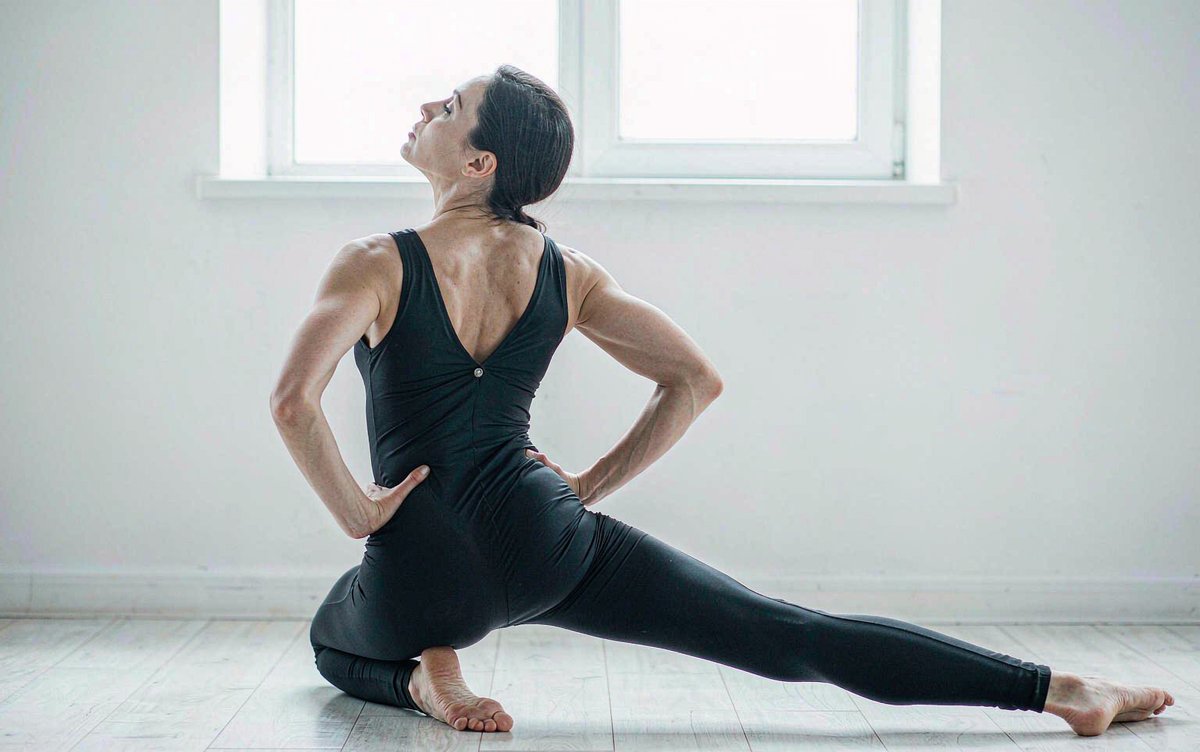
Standing fit is the easy test. The gap shows up when the vertical path has to stretch. (AI-generated image)
Where the Vertical Tension Actually Comes From
Standing is a static check, and a forgiving one. An athletic jumpsuit joins the bodice and the leg, so movement changes several distances at once: shoulder to chest, chest to waist, waist to crotch, and the back rise over the seat. If the total is short, the garment borrows length from wherever it can — usually by pulling the crotch up and the neckline forward.
| Zone | What a shortfall tends to look like |
|---|---|
| Shoulder to chest | Neckline lifts or gapes, strap position rides, upper chest coverage drops |
| Chest to waist | Horizontal pull lines across the midriff, front panel feels tight in a reach |
| Waist to crotch | Crotch climbs, seat feels high, sitting or squatting feels restricted |
| Back rise over the seat | Back panel limits bending, waistband dips, centre-back seam pulls |
Pattern-making advice usually says to add or remove length zone by zone rather than moving everything at once, and that is the right instinct here too. But be careful with the source: sewing-pattern guidance is written for woven garments and home sewing, not for stretch activewear. Elastane absorbs some of the shortfall, which is exactly the trap. The garment feels acceptable standing up because the fabric is stretching to cover the gap, and that stretch becomes continuous tension the moment you move.
Measure Torso Length the Same Way Every Time
Before you compare two samples, agree on what you are measuring. There are at least two common definitions of torso length: a vertical line from the high point of the shoulder down to the crotch, and a loop that runs from the shoulder, down the front, between the legs and back up. Those two numbers are not interchangeable. Whichever you choose, write it on the spec sheet.
| Measurement | What must be written down |
|---|---|
| Torso length | Start point, path, end point and the posture of the person being measured |
| Front shoulder to crotch | Measured along the garment surface or on the body; whether strap and crotch panel are included |
| Back shoulder to crotch | Same method as the front, so the two can be compared |
| Strap length and position | Attachment points on the finished garment and the adjustment range |
| Crotch dimensions | Panel width, front and back rise depth, seam position |
Photograph the same four things every time: the body measurement being taken, the sample laid flat with the front and back torso lines marked, the strap and crotch panel as built, and the same wearer standing, bending forward and squatting so the three paths can be compared side by side. Photos are not evidence on their own, but they stop two people from arguing about what "the same measurement" meant.
Treat Torso Length as Its Own Variable
Two wearers can share the same bust, waist and hip and still need different torso lengths. That is why girth grading alone keeps producing jumpsuits that fit one body type and fight another. Put torso length on one axis and girth size on the other, and mark each cell as supplied, verified or still open.
| Torso ↓ / Girth → | Small | Medium | Large |
|---|---|---|---|
| Short | Observe / to verify | Observe / to verify | Observe / to verify |
| Regular | Observe / to verify | Base sample candidate | Observe / to verify |
| Long | Observe / to verify | Observe / to verify | Observe / to verify |
Illustrative example (not measured data)
Here is how a brand might use that grid — a worked scenario to show the logic, not test results from any product. Say you sell three girth sizes and see customers in three torso lengths. You start with the regular-torso, medium-girth cell as your base sample. Then you add the two cells most likely to break: long torso with large girth, where a short front path lifts the crotch hardest, and short torso with small girth, where the back rise can pool and the neckline can stand away. Suppose the long-torso cell shows the crotch climbing in a deep squat while the neckline stays put. That tells you the missing length sits in the waist-to-crotch zone, not at the shoulder — so the correction is a front and back rise adjustment in that zone, retested on the same fabric and the same wearer. It does not follow that the short-torso cell needs the same change. Each cell you verify costs a sample and a fitting round, which is why you test the extremes first instead of grading the whole range on paper.
For the engineering side of how a one-piece is built and balanced, our activewear bodysuit and jumpsuit engineering FAQ covers it. If your range extends into larger sizes, it is also worth reading our plus-size bust and underbust development guide — the same principle applies: girth and length are two different variables, and one does not predict the other.
Diagnose Before You Cut
"Add length" is not a diagnosis. The same symptom can come from three different causes, and fixing the wrong one makes the next sample worse.
| Symptom | Review first | What people get wrong |
|---|---|---|
| Strap drags down and neckline tightens when the arms lift | Strap position, torso length, upper-body movement room | Assuming the neckline is the problem when the pull starts lower down |
| Crotch climbs in a squat | Total torso length, front and back rise, crotch panel shape | Shortening the strap when the real gap is waist-to-crotch |
| Neckline fits standing, gapes after movement | Coverage after the bodice is pulled, strap and neckline shape | Treating it as a sizing issue for the customer |
| Abdomen or back panel pulls when seated | Waist and back panel, bend allowance, front versus back | Judging only the front view |
| Crotch hangs loose | Torso possibly too long, or rise depth badly distributed | Shortening the straps as a quick fix |
A short vertical path and a shallow crotch curve leave different pull lines, so they have to be judged separately. Run the next round as a controlled test rather than a group discussion:
- Fix the wearer and the fabric. Change nothing else.
- Change torso length only. Watch the shoulder, chest and crotch together.
- Then change strap position or adjustment range as a separate step.
- Then review the crotch panel and curve.
- Repeat the same movements and the same camera angles each round.
If you change three things at once and it improves, you have learned nothing you can repeat. One variable per round is slower on paper and faster in practice.
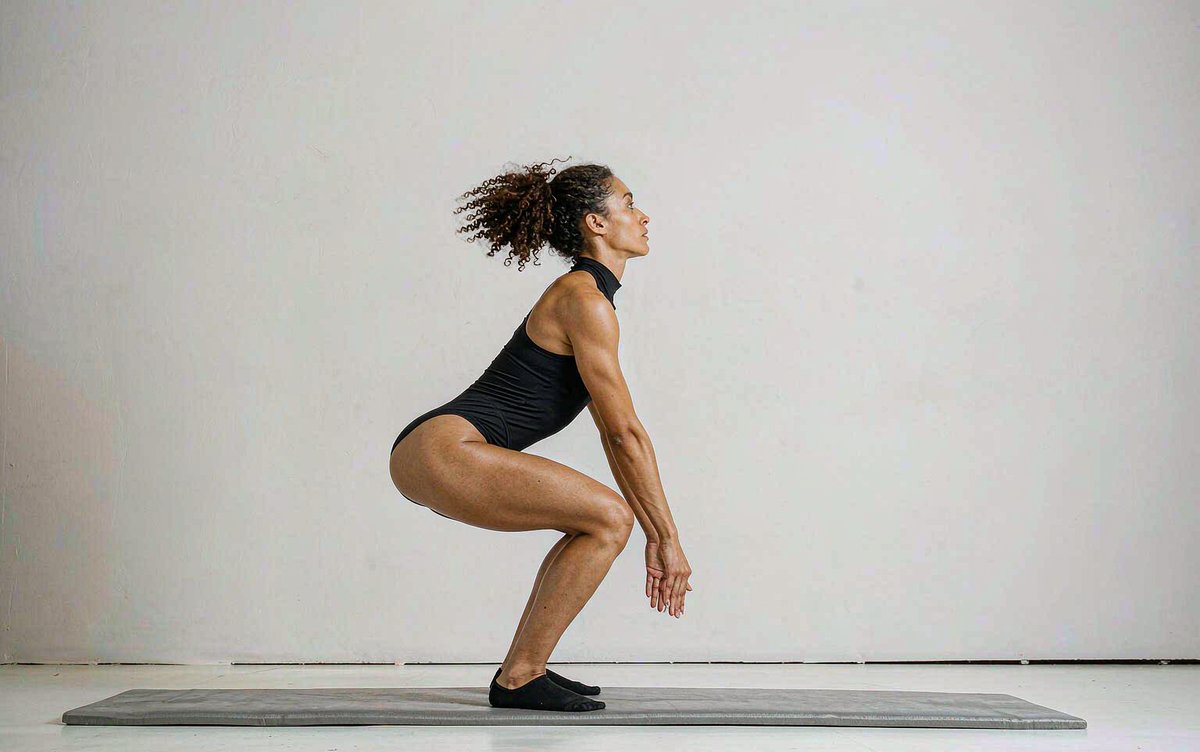
In a squat, a short torso path shows up as crotch lift — not as a sizing problem. (AI-generated image)
Build the Movement Tension Matrix
This is the second deliverable, and the one most brands skip. Standing fit tells you almost nothing about whether the vertical path is long enough. Test the actions the product is actually sold for.
| Movement | Watch for | What to record |
|---|---|---|
| Standing | Starting neckline, strap and crotch position | Front, side and back views |
| Arms overhead | Strap load, neckline shift, underarm and upper-chest coverage | Same-angle photo or video frame |
| Forward bend | Back panel load, back neckline, waist pressure | Mark where the pull lines appear |
| Sit and stand | Crotch, seat and abdomen pressure; whether the wearer has to readjust | State after the movement, not during |
| Deep squat | Crotch lift, back panel stretch, neckline and strap change | Lowest point and recovery |
| Sport-specific action | The real movement for yoga, Pilates, training or dance | Brand-defined check |
Do not publish a universal pass figure such as "crotch may rise 5 mm" or "fabric must recover in 30 seconds". Those numbers mean nothing without the fabric, the size, the body and the test condition. What you can define is what counts as unacceptable for your product: repeated manual readjustment, a pressure mark that stays after the garment comes off, or a neckline that will not return to its starting position. Write those down before the fitting, so the decision is not made by whoever speaks loudest in the room.
Wash It, Then Approve It
A jumpsuit can pass every movement test and still change shape after the first wash. Record the care condition with the result, or the result is not usable.
- Wash conditions, drying method and number of cycles;
- Torso path, strap position and neckline opening before and after;
- Whether the movement matrix was repeated after washing;
- Fabric, seam and strap condition after care;
- The limits and exceptions your brand has approved.
| Item | What the approval record holds |
|---|---|
| Version | Sample, pattern and tech pack version |
| Key dimensions | Torso line, strap, neckline and crotch dimensions with tolerances |
| Materials | Main fabric, lining, strap material and lot |
| Verification | Wearer, size, movements, pre- and post-wash conditions |
| Open items | Owner, deadline and whether it blocks bulk |
Keep the approval attached to a specific style and version. A torso correction approved on one jumpsuit does not travel to the next one just because the fabric is the same. For the wider checklist that sits around this record, see our fit sample approval checklist.
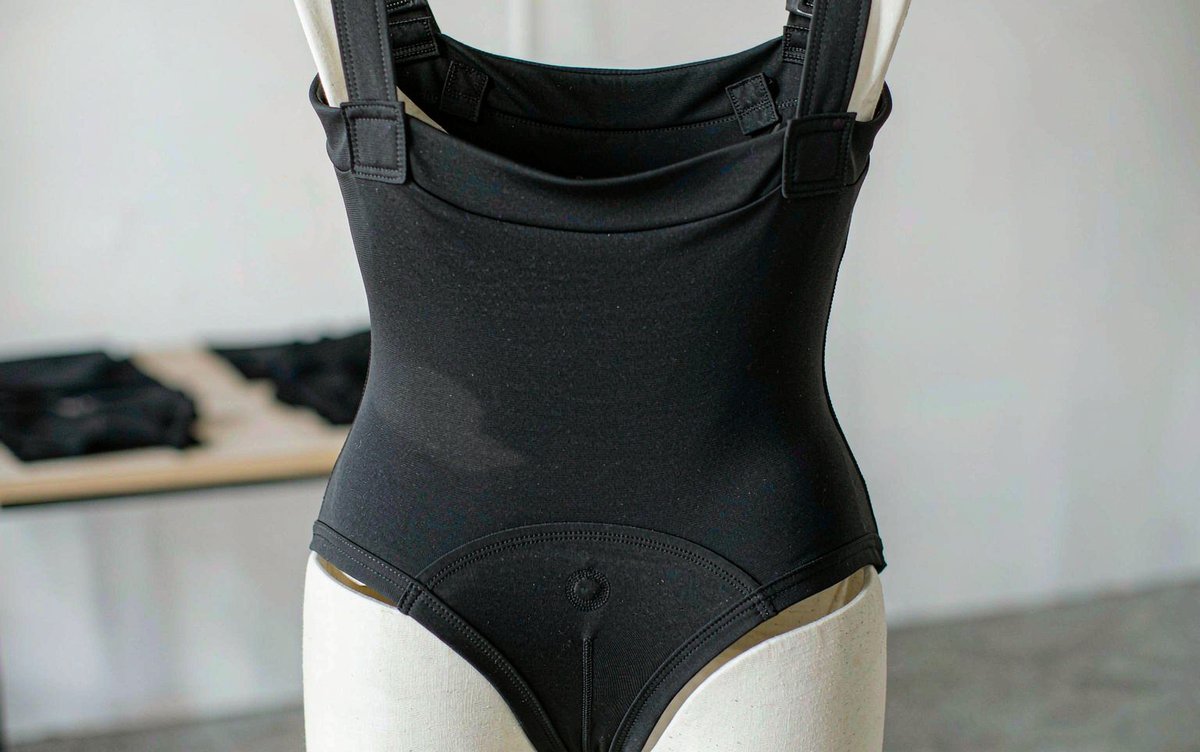
Strap attachment, neckline shape and crotch panel are separate parts to verify. (AI-generated image)
FAQ: Athletic Jumpsuit Fit
Why does a jumpsuit fit standing but pull when I squat?
Because squatting lengthens the shoulder-to-crotch path, and standing still never tests that distance. Check torso length, strap position, crotch panel and back rise separately instead of judging from one point.
Can a longer strap fix crotch tension?
Sometimes it shifts load, but it does not add length between the waist and the crotch. If the shortfall sits lower down, a strap change will move the problem rather than solve it. Confirm with a one-variable sample round.
Should torso length be graded the same way as chest and hip?
Do not assume so. Girth and torso length are different variables, and a size range built only on girth will fit some bodies and fight others. Build the combination from your target body data, then choose which cells to verify.
Can stretch fabric make up for a short torso?
It absorbs some of the gap, but it converts the rest into continuous tension: crotch lift, neckline drag, and a garment that needs readjusting after every movement. Stretch hides the problem standing still; it does not fix the pattern.
Start With One Style and One Matrix
Pick a single jumpsuit, define how you measure torso length, and build the length-by-girth grid before you cut anything. Mark what you already supply, what you have actually verified in movement, and what is still open. Then change one variable per round, keep the photos at the same angles, and wash one sample before you approve the lot. The goal is not a longer spec sheet. It is being able to say, for any size you sell, how long the torso path is, where the length sits, and what you tested to prove it.
If you are developing an athletic jumpsuit and want to talk through which torso and girth combinations to sample first, share your intended range, fabric and target movements. We develop one-piece activewear on a made-to-order basis and can turn the matrix into a sample plan.