Top 10 Criteria for Choosing a Reliable Men's Active Shorts Manufacturer
Men's 2-in-1 training shorts are the standard for running, lifting, and functional fitness. Male athletes require durability on the outside to withstand barbell friction, and a supportive, friction-free layer on the inside to prevent chafing.
You need a factory that knows how to build gear that takes abuse. At Call The Style, we rely on heavy-duty stitching, exact pattern engineering, and functional hardware. Ask your potential supplier these 10 practical questions to verify their experience before you place a bulk order.
1. The Inner Liner: Stopping Thigh Chafing
The Common Problem: Rough Seams on the Skin
The primary purpose of the inner liner is to protect the inner thighs from rubbing together. If a factory uses cheap, abrasive polyester or sews the inner leg seam with a standard raised overlock stitch, the athlete will suffer from severe chafing and red marks after a three-mile run.
The Factory Solution: Brushed Micro-Knits and Flat Seams
We solve this with material choice and machine selection. The liner must be a high-spandex, brushed micro-knit for a soft hand-feel. More importantly, we sew the entire inner liner using 4-Needle 6-Thread Flatlock machines. This joins the fabric edge-to-edge with no raised seam allowance, leaving a completely flat surface against the thigh.
2. Preventing Crotch Blowouts
The Common Problem: Ripped Outer Shells
The outer shell of a training short is usually a woven fabric (like a nylon/spandex blend) that repels water and resists barbell scraping. However, woven fabrics have limited stretch. If a man does a deep squat, a standard four-way seam intersection at the crotch will take the full load and tear immediately.
The Factory Solution: The Spandex Gusset Panel
We remove the tension point. Instead of having four seams meet in the middle, we insert a separate panel of fabric called a gusset. Often, we use a higher-stretch knit fabric for this specific crotch panel on the outer shell, giving the shorts the mechanical stretch needed for deep lunges without ripping.
3. Phone Storage: Stopping the Bounce
The Common Problem: Heavy, Swinging Pockets
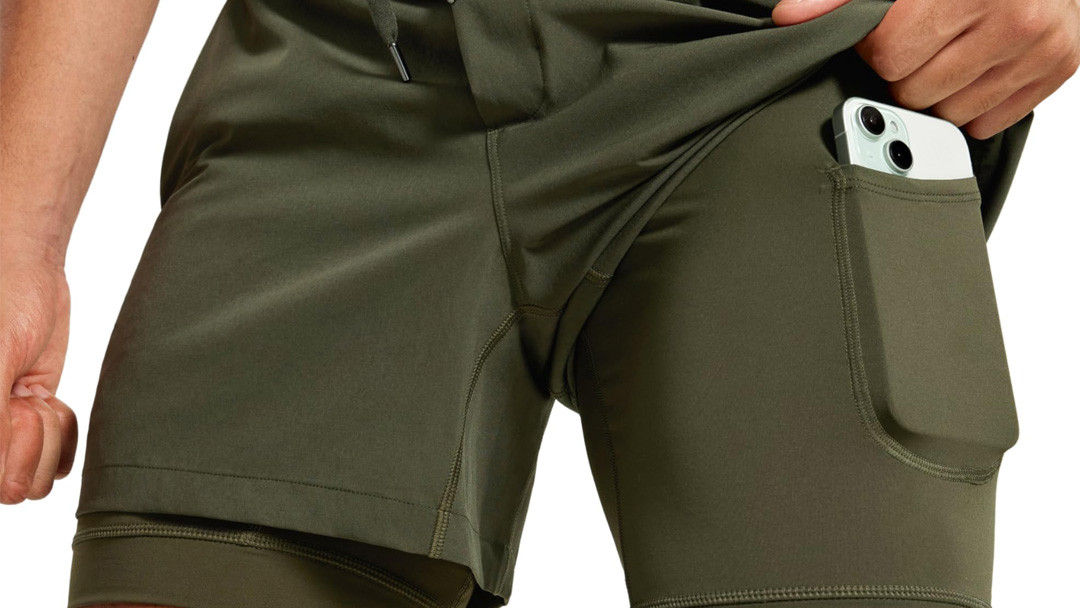
If you put a smartphone in the standard side pocket of a loose outer short, it swings violently and hits the knee or thigh during a run, throwing off the athlete's balance.
The Factory Solution: Dedicated Liner Compression Pockets
We anchor the weight. We build a dedicated, drop-in phone pocket directly onto the side of the inner compression liner. Because the liner is tight against the skin, the phone is locked securely to the thigh and does not move at all during exercise.
4. The Liner Ride-Up
The Common Problem: Shorts Bunching at the Groin
If the tension around the bottom hem of the inner liner is too loose, the fabric will slowly ride up the thigh during a workout, forcing the athlete to constantly pull them back down.
The Factory Solution: Silicone Grippers
Depending on the design requirements, we manage this by calculating the exact opening circumference relative to average thigh sizes. For higher performance lines, we apply a thin strip of medical-grade silicone grip tape to the inside of the liner hem, which gently holds the skin without pulling leg hair.
5. Waistband Stability: No More Rolling
The Common Problem: Twisted Elastic Bands
A loose piece of elastic inside a fabric waistband will twist, fold in half, and permanently deform after a few washes, digging painfully into the wearer's waist.
The Factory Solution: Multi-Needle Encasing
We lock the elastic down. We use a multi-needle sewing machine (usually 3 or 4 needles) to stitch directly through the fabric and the elastic band simultaneously. This secures the elastic in flat, even rows so it can never twist or fold over.
6. Managing Heat: The "Oven" Effect
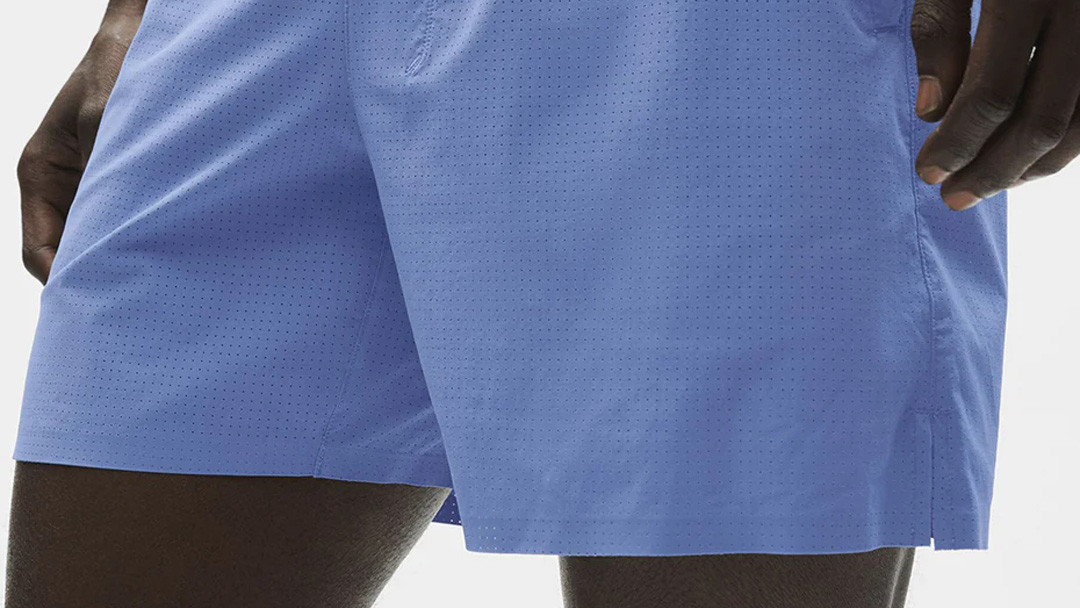
Wearing two layers of fabric over the groin and thighs traps a massive amount of body heat. If the outer shell isn't breathable, the shorts become an oven. We address this by engineering ventilation zones. We often use laser-cut perforation holes on the side panels or back yoke of the outer shell, or insert warp-knit mesh panels to allow heat to escape. (Read more about how we test fabric breathability in our Yoga Pants Guide.)
7. Anchoring the Drawstring
Customers hate it when they wash their shorts and the drawstring pulls completely out. To prevent this, we sew a vertical Bar-Tack stitch directly through the center-back of the waistband, permanently anchoring the midpoint of the cord to the shorts. It takes our operators an extra few seconds per garment, but it eliminates a major return reason. (See our assembly line checks in our Quality Control Breakdown.)
8. Odor Control on the Inner Liner
Since the inner liner sits tight against sweating skin, it breeds bacteria quickly if made with cheap materials, leading to a permanent bad smell. We source fabrics treated with stable anti-microbial finishes (like silver-ion treatments) for the liner layer, which stops bacteria growth at the fiber level. We also ensure all treatments comply with international safety standards. (Learn more in our Eco-Friendly Guide.)
9. Shrinkage Mismatch: Knit vs. Woven
The biggest manufacturing error in 2-in-1 shorts is ignoring fabric behavior. The knit inner liner will naturally shrink more in the wash than the woven outer shell. If not accounted for, the liner will pull the outer hem up, warping the shorts. We calculate separate shrinkage tolerances for both fabrics and adjust the pattern grading before cutting. (Avoid these dimensional errors with our Tech Pack Mistake Guide.)
10. Testing Before Scaling (Low MOQs)
Men's sizing can be tricky, and getting the tension of the inner liner right requires testing. You shouldn't have to order 1,000 pairs just to test the fit. We operate an agile production line, allowing you to launch new men's activewear collections with MOQs starting at just 100 to 300 pieces per style. (See how this protects your cash flow in our Cost Analysis Guide.)
Manufacture Gym Shorts Built for Abuse
Stop dealing with ripped crotch seams, chafing liners, and twisted waistbands. Partner with Call The Style for heavily reinforced, highly functional men's activewear.
START YOUR PROJECTFrequently Asked Questions (FAQ)
Q: How do you stop the inner liner from riding up the leg?
A: We manage this by optimizing the hem tension against the thigh. For high-intensity shorts, we apply a thin strip of silicone grip tape to the inside of the liner hem to anchor it to the skin.
Q: What is the best way to design a phone pocket for running shorts?
A: A loose outer pocket causes the phone to bounce. We construct a tight drop-in pocket directly on the side of the inner compression liner. This holds the phone securely against the thigh, eliminating movement.
Q: Why do the crotch seams on woven gym shorts rip during squats?
A: Woven fabrics don't stretch enough for deep lunges. A proper factory removes the intersecting seam and inserts a stretch knit fabric panel (a gusset) into the crotch to provide mechanical flexibility.
Q: How do you prevent the elastic waistband from twisting in the wash?
A: We use a multi-needle machine to stitch directly through the fabric casing and the elastic band simultaneously. These rows of stitches lock the elastic permanently in place so it cannot roll or fold.