Home / All / Buyer Guides / Maternity Activewear Manufacturer: Stretch, Support and Coverage
Maternity Activewear Manufacturer: Stretch, Support and Coverage
Nov 18,2026
Sourcing guide · Maternity activewear
If you're building maternity activewear, start with the changing fit—not a bigger version of your standard leggings. Decide where the waistband sits, how the front panel expands without unwanted pressure, what the bra needs to support, and how coverage holds up as the garment stretches. Then ask the manufacturer to show those decisions on real wearers in the production-intent fabric. A soft swatch and a promising size M sample are only the beginning.
The hard part is that customers do not change in one neat, proportional way. A brand cannot promise one legging will suit every person through every stage just because the fabric stretches. The practical goal is a clear intended wearer, a defined fit range, and an approval record that the next production run can follow.
1. Define the wearer and product brief
Who is this garment actually for?
A prenatal yoga legging, a walking set and a nursing-friendly studio outfit can share a color palette while requiring different construction. Start with the activity, intended pregnancy or postpartum use, climate, preferred coverage and the customer's existing fit complaints. Is the request for room at the front belly, a waistband that folds down, longer tops for coverage, or a bra that is easier to adjust? Put those answers in the product brief.
A useful brief makes the boundaries visible. “Prenatal yoga” could mean low-impact studio wear for someone who prefers full belly coverage. “Postpartum” may mean a fold-down waist and a different dressing experience. A single style can serve more than one use, but say which uses you intend to validate instead of treating every stage as interchangeable.
What does published body-measurement evidence tell us?
There is a good reason to avoid designing from one stock mannequin. A small longitudinal apparel study scanned 20 participants at multiple points in pregnancy and reported average changes of 2.7 inches at the bust, 8.8 inches at the waist and 3.3 inches at the hip over its observed period. Those are study averages, not a maternity grade chart or a promised amount of growth for any individual. The useful production lesson is that bust, waist and hip did not change by the same amount. Read the study abstract and methods before applying its findings to your own target market.
Reported mean circumference change in one 20-person longitudinal study
Bust
2.7 in
Waist
8.8 in
Hip
3.3 in
Source: Balasubramanian et al., Longitudinal anthropometric changes of pregnant women: dynamics and prediction. Averages from 20 subjects over the study's observed pregnancy period. The chart compares measurements within that study only; do not use these values as fixed pattern increments, size recommendations or individual predictions.
Which fit decisions should appear in the first factory brief?
Give the pattern team a target size range, product use, preferred waist position, coverage expectation, sample color and a reference for the intended silhouette. Say whether a bra needs nursing access and whether the legging must work in more than one waistband position. If your own customer reviews mention rolling, slipping or tight bands, include the actual complaint. The brief should describe a problem the first sample can test.
My first question to a maternity activewear manufacturer would be: “Which parts of this pattern can change independently?” If the only answer is “We'll size up the waist,” there is still a lot to resolve about rise, front length, side seam, back waist and how the fabric returns after wear.
2. Build maternity leggings around the belly panel
Over-bump, fold-over or under-bump?
Over-bump, fold-over and under-bump designs solve different preferences. The panel shape, seam location, elastic choice and fabric recovery matter as much as the number of centimeters above the waist. A high panel that rolls in a seated position is not improved by making it higher.
Three waistband directions to sample; none is a universal fit
Construction
Potential use
Approval question
Over-bump panel
Extended front coverage with a dedicated belly panel.
Does the top edge stay in place while standing, seated and moving? Where does tension collect?
Fold-over waistband
Two wear heights from one construction, if the fold sits smoothly.
Does either position roll, bunch, expose skin or put an uncomfortable seam against the wearer?
Under-bump waist
A lower front placement for customers who prefer their abdomen uncovered.
Does the front dip too far in movement, and does the back stay anchored?
A real product example: Nike (M) One maternity leggings use an extra-wide foldable waistband. That illustrates one design route; it does not prove a fold-over panel will work in your fabric or for your buyers. Call The STYLE also lists a fold-over yoga pant described as maternity-friendly. Treat that existing pattern as a development reference. A dedicated maternity claim needs fit review on the intended pregnant wearers and the exact finished garment.
Where should the panel expand, and where should it stay anchored?
Follow the path of tension rather than judging the waistband from a front photograph. Check the top edge while seated, the front curve as the wearer moves, the side seam where the panel meets the body fabric and the back waist after walking. If the front rolls but the back remains stable, change the front construction first. If the whole legging slides down, the problem may be broader than panel height.
In the tech pack, separate the front panel height, back rise, fold line, elastic tension and side seam from the general “waist” measurement. For custom maternity leggings, this makes sample feedback actionable: “The front top edge rolls when seated” is much easier to correct than “make it more supportive.”
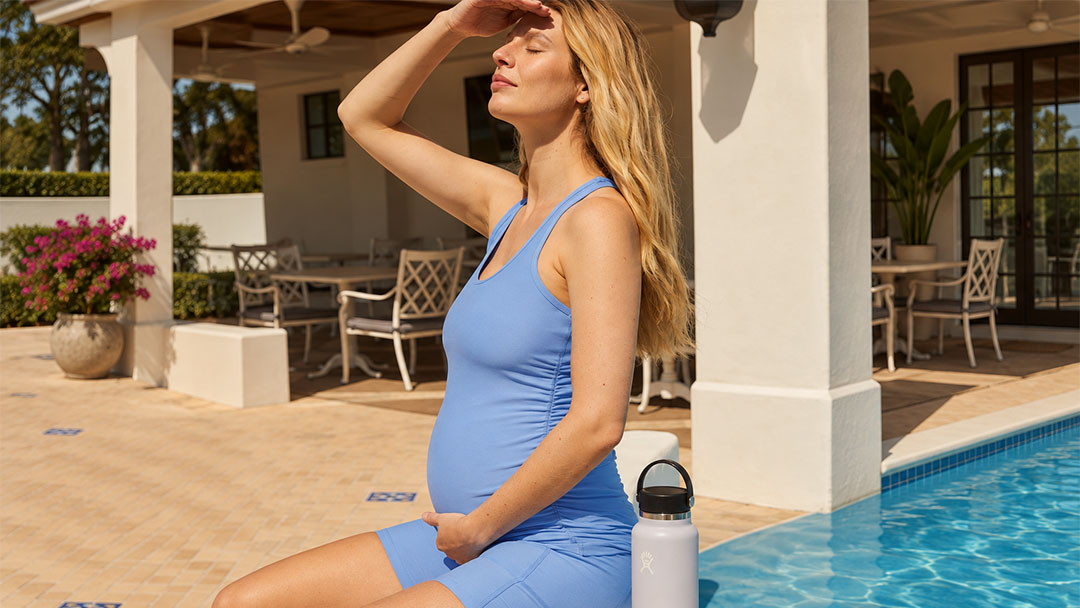
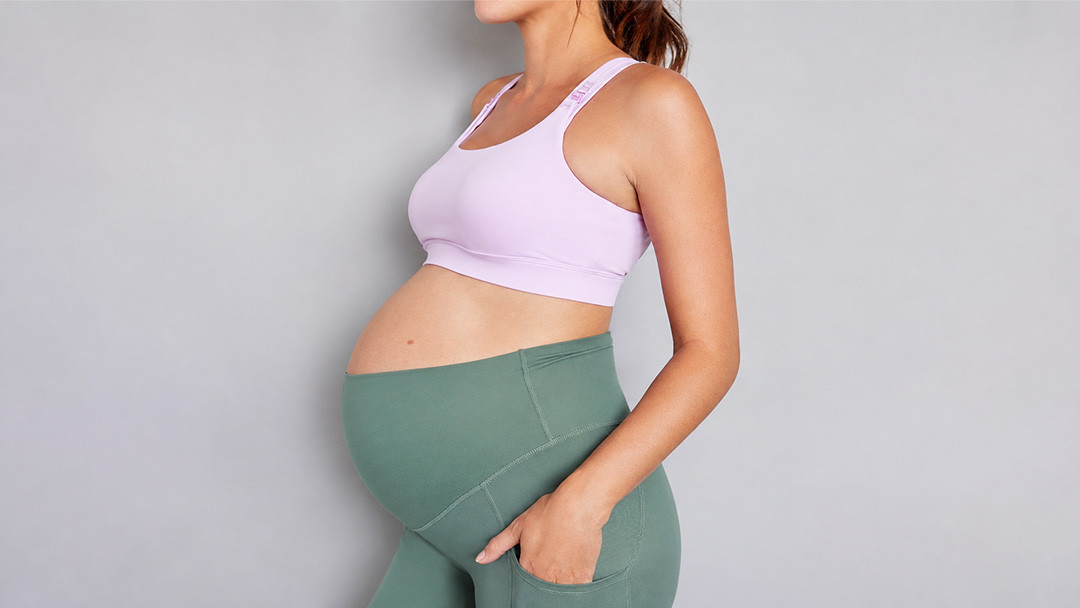
A lifestyle view of maternity activewear silhouette and coverage. Fit and fabric performance should be checked on the finished garment.
What fabric evidence should the supplier provide?
“Four-way stretch” tells a buyer too little. Ask for the exact fabric code, fiber composition, knit, GSM, finish, stretch behavior and recovery after extension. Compare the production-intent fabric in the intended color. A black swatch can look opaque while a pale sample becomes more revealing when its front panel stretches.
There are two different questions here. A fabric test can measure defined stretch and growth properties; ASTM D2594/D2594M-21 is one published method for low-power knitted fabrics, with its own stated limits for support applications. A finished-garment fit review asks whether the sewn legging remains comfortable and covered on actual wearers. One does not replace the other. If the brand needs a laboratory report, agree the appropriate method, test conditions and acceptance criteria with the mill or lab before sampling.
How should the brand check coverage and comfort on the sewn sample?
Make the sample in the intended color and construction. A panel may feel fine in isolation but behave differently once joined to the waistband and leg body. Agree where and how the wearer will move, who will record the observations, and what counts as a reason to revise the sample. Photograph construction and garment position only with the wearer's consent.
Check front and back separately. Ask the wearer to stand, sit, walk and perform movements relevant to the product brief. Note whether the panel shifts, the crotch and seat remain covered, the seam rubs, and the garment recovers after being removed. Record the size, color, sample version and lighting. That record is worth more than writing “squat-proof” on a swatch card.
A maternity sports bra is not just a larger band on an existing yoga bra. Bust volume, underband feel, strap position, cup coverage and how easily the bra is put on can all change the experience. If nursing access is part of the brief, define how the opening works while the other side stays covered; do not assume every prenatal bra also needs a nursing closure.
Ask the wearer to put the sample on without assistance, then review the underband seated and moving. Check whether the cup edge or side seam cuts in, whether the straps stay in position and whether the back construction holds its shape. “More support” is too broad for a correction sheet; “the size L underband feels tight when seated” gives the developer a place to start.
When does nursing access belong in the design?
A prenatal bra and a nursing bra may look similar on a mood board, but an access opening changes closures, cup layers and how much coverage remains when one side opens. Decide that feature at the brief stage, specify how it works, and test it on the actual sample. Do not add a nursing claim to a bra developed only for prenatal exercise.
The American College of Obstetricians and Gynecologists advises a supportive sports bra for exercise during pregnancy. That is general exercise guidance, not proof that a particular bra delivers clinical support. For a manufacturer, the practical response is to agree the intended activity and test the band, cups, straps and movement on the actual size range.
What can an existing product example teach a buyer?
For a concrete design comparison, Nike describes adjustable cup capacity and an adjustable bottom band in its Nike (M) Swoosh nursing sports bra. The point is the adjustable architecture, not a claim that Call The STYLE makes it or that a similar bra would automatically pass your fit approval. Use custom sports bra styles as construction references, then brief the pregnancy or nursing-specific changes you want sampled.
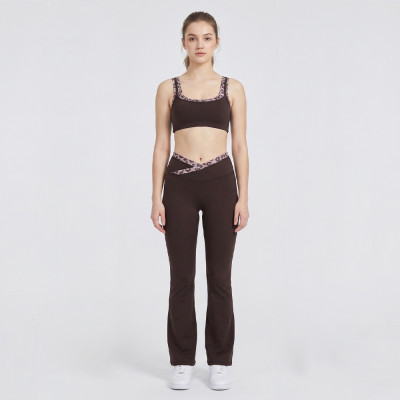
The curved waistband shows an under-bump design direction. Check its position, comfort and coverage on the finished sample.
4. Validate the size range with real samples
Which measurements describe bodies, garments and grade rules?
“Fits all trimesters” is a difficult claim to defend without a defined body range and wear evidence. A size chart needs target body measurements; a garment spec needs actual finished dimensions; a pattern grade sets out how each panel changes. These are related documents, but they are not interchangeable. ISO 8559-3 explains principles for body-measurement tables and explicitly excludes finished garment dimensions.
Which sizes and wearers belong in the fit review?
Start with a base size, then review representative smaller and larger sizes. Include more than one relevant pregnancy stage in the wear review if the product is marketed for multiple stages. Record the wearer's measured dimensions voluntarily and privately, the sample size, stage, waistband setting, and any pressure, slipping or coverage comment. Do not treat a week of pregnancy as a universal body measurement. The activewear size-grading guide explains how waist, rise, hip and bra construction may require different grade rules.
Write down the limits of the review. If a product has been fitted only on an M and L, do not present an XS-to-XXL fit claim as tested. If only a later-stage over-bump fit has been checked, do not claim the same result for early pregnancy or postpartum use. Those gaps tell the sampling team what to test next.
Sample comment that a pattern team can use: “On the size L sample, the front waistband edge rolls while seated and the back waist stays stable. Review the front panel height and top-edge tension; keep the approved back rise. Retest the revised L and base M in the intended fabric.” This is an illustrative fit note, not a report from a completed customer project.
What would a useful A/B wear test look like?
Here is a proposed development test for a maternity leggings factory and its brand buyer. It has not been run for this article. Make the same legging design in two candidate fabric-panel combinations, using the intended bulk materials. Recruit consenting wearers across the planned sizes and relevant pregnancy stages. Have them try each version in the same types of standing, seated and product-relevant movement. Document observations without publishing identifiable photos or health details.
Proposed A/B sample log: define pass criteria before collecting feedback
Check
Record for sample A and B
Possible decision
Waistband position
Top edge before and after sitting and movement; any rolling or slipping.
Revise front curve, panel depth or edge construction.
Comfort and dressing
Wearer's own pressure description and ease of putting on/removing, by size.
Change tension, entry or panel construction.
Coverage
Front, seat and crotch in the actual color under agreed lighting.
Revise fabric, fit or color; retest the changed version.
Recovery and wash
Dimensions and appearance after the agreed wear and care cycle.
Request material evidence or change the fabric.
How does a brand decide whether the sample passes?
Set acceptance criteria before asking wearers to compare versions. A brand might decide that repeated waistband rolling, a visible coverage failure in the intended color or a closure that cannot be used as designed requires a revision. The numerical thresholds, participant mix and care cycles belong in the specific product test plan; this article cannot supply universal pass marks. Record a fail, assign a correction, then retest the changed sample rather than approving it with an open note.
Do not claim “tested through pregnancy” because one wearer tried one size once. Report exactly which versions, sizes, stages and conditions were checked. A small wear panel is excellent for finding failure points; it cannot establish a universal safety or fit result.
5. Turn approved fit into a repeatable production specification
What belongs in a maternity activewear tech pack?
Good maternity activewear development needs a versioned product specification. A photo labeled “maternity-friendly” cannot tell the factory what to cut next month. Send panel measurements and construction notes that distinguish the belly from the hip, and distinguish a sports bra's support requirement from any nursing-access requirement.
Factory-ready fields to complete for each maternity style
Field
Record in the specification
Approve against
Intended use
Prenatal, postpartum or nursing use; activity; target body and size range.
Written buyer brief and care/claim review.
Legging geometry
Front panel height and curve, back rise, fold line, hip, inseam, gusset, seam and elastic details.
Pattern version, measured size set and wear notes.
Bra construction
Underband, cup coverage, lining, straps, closures and access if applicable.
Production-intent material and agreed test evidence.
Branding and delivery
Logo size/placement, care labels, packaging and carton details.
Approved pre-production garment and packed unit.
How do sample approval and bulk quality checks connect?
Keep a revision number on the pattern, measurement sheet, fabric and trim list, fit comments and approved sample photos. Before bulk, compare the pre-production garment with that same approved package. During production, use agreed measurement tolerances and construction checks on the relevant sizes; if the panel fabric or closure changes, reopen the affected fit question. A reorder should identify the approved version, not rely on someone remembering “the black maternity set.”
Leave product-specific measurements blank until there is an approved sample. A made-up “ideal” belly-panel height or compression percentage in a generic article would be false precision. If support level matters, the activewear compression guide helps frame garment-level questions, but pregnancy fit still requires its own review.
6. Compare the manufacturer, MOQ and quote
How many garments does a small range actually require?
Call The STYLE states a standard starting garment MOQ of 100 pieces per style and color in its activewear MOQ calculator. For planning only, one maternity legging in black is 100 garments; adding one maternity bra in black makes 200; adding a second color to each makes 400. That arithmetic is not demand data, and custom fabric, special trims or an alternate construction may bring separate minimums. Confirm the actual quote before committing to a product launch.
If your team is testing over-bump and under-bump versions, ask the manufacturer whether they count as separate styles. Do not assume two different waistband patterns can share one 100-piece style minimum. Likewise, a nursing sports bra with a different closure may be a separate development and production line from a standard maternity bra.
What should the first inquiry include?
For a first inquiry, send a reference sketch, intended wearer and activity, target sizes, preferred waistband and bra construction, planned colors, quantity by style/color, candidate fabric, logo, destination market and target date. Ask for separate sample, revision, fabric, trim, garment and packing costs. A quote for “maternity yoga set, 100 pieces” is too vague to compare responsibly.
What evidence shows a factory can repeat the approved fit?
Ask two or three shortlisted maternity activewear manufacturers to explain who develops the pattern, who checks the size set, what happens when a fabric code changes and how a reorder identifies the approved version. Compare a physical sample, its measurement sheet and the correction history. A confident sales answer is useful; the records tell you what production will follow.
Ask who owns each correction and how a fabric substitution is approved. Request an example measurement sheet, versioned sample comment record and a clear explanation of size-set approval. When comparing quotations, check whether both suppliers are pricing the same construction, fabric, tests, color count and packing. A lower unit price on an undefined garment is not a meaningful comparison.
For Call The STYLE, the custom yoga pants and leggings range and the fold-over style mentioned above are possible starting references. They are not published evidence that a dedicated maternity size range has already been validated. The honest next step is to develop and fit-test the customer's specified product before any broad pregnancy or postpartum performance claim.
My view: an adjustable waist is an idea, not an answer. The brand has an answer when a wearer can sit down, stand up and move in the garment, tell you where it feels right or wrong, and the factory can reproduce that exact version.
Share your intended wearer, activity, waistband or bra concept, size range and starting quantity per style and color. Call The STYLE can discuss a sample brief, material options and a made-to-order quote based on the construction you want to validate.
The 20-person study's bust, waist and hip figures are reported sample averages; they are used only to explain why proportional enlargement is a poor default. The bar chart is a visual representation of those published averages, not Call The STYLE testing or universal sizing data. The A/B table is a proposed wear-test protocol without results. Nike's product and design pages illustrate approaches used by another brand; Nike is not presented as a Call The STYLE customer. ACOG's exercise advice provides context, not a certification or health outcome for any garment. Site links show published product and service information; project-specific maternity capability, fit results, claims and MOQ must be confirmed on the actual sample and quote.
Can a regular legging pattern simply be graded up for pregnancy?
It may be a starting block, but a maternity product needs a separately reviewed front panel, rise, waistband and size set. Test the intended construction and fabric on the wearers and stages named in the product brief.
Is over-bump better than under-bump?
Neither works for everyone. Choose based on the intended wearer and activity, then check pressure, rolling, slipping and coverage in the actual size range. A fold-over version creates another option but needs both positions tested.
Can the same maternity leggings fit every trimester?
A stretch or adjustable panel can accommodate a defined range, but no one should promise universal fit without a documented body-size range and wear evidence. Explain the intended fit and sizing limits on the product page.
Does a maternity sports bra need nursing access?
Only if nursing is part of the product brief. Support, cup capacity and access are separate decisions. Test the chosen closure and coverage on the actual garment when nursing use is claimed.
What tests should a brand request for maternity activewear fabric?
Start with the actual fabric's stretch and growth behavior, colorfastness and any agreed opacity or surface requirements. Agree the method and acceptance criteria with the mill or lab. Then assess the finished garment for fit, comfort and coverage on real wearers.
What is the MOQ for a custom maternity legging and bra?
Call The STYLE's published standard starting point is 100 pieces per garment style and color. A legging and bra are two styles. Confirm the actual MOQ and any separate material or trim minimum after the designs, colors and materials are specified.